Ask five contractors in Harrisburg when the best month to pour concrete is and you'll get five different answers, because the honest answer is a window, not a date. Concrete doesn't care what the calendar says. It cares about temperature, moisture, and how fast the surface loses water compared to how fast the mix underneath is setting up. Get that mismatch wrong and you end up with scaling, crazing, or a slab that never reaches the strength the mix design was supposed to give it.
What concrete actually has to do to cure right
Fresh concrete has to stay above 50°F for the first several days for the hydration reaction to keep moving. Below that, it slows down hard, and if the slab drops below freezing before the mix hits roughly 500 psi, ice crystals form inside it and the damage is permanent, not just a delay. That's why nobody wants to pour a driveway here in the middle of January without doing something extra to protect it.
A driveway poured on a good fall day is usually safe to walk on the next morning and to park a car on within about a week. It won't hit its full 28-day design strength until, well, 28 days out, and that timeline holds in any season. Cold just stretches it. Heat compresses it, sometimes more than you'd want.
Heat brings its own trouble. On a 90°F day with low humidity and a breeze, the surface of a slab can dry out faster than the concrete underneath is curing. That's plastic shrinkage cracking, and it shows up as thin cracks across the surface within hours, sometimes before the final finish pass is even done. We manage it by pouring early in the day, misting the surface, using an evaporation retarder, or covering with curing blankets. It's manageable. It just takes more attention than a mild-weather pour does.
The Harrisburg calendar, realistically
Spring (March through May) looks like the obvious time to start, and it can work, but central Pennsylvania spring runs wet. Frost is coming out of the ground, the water table is up, and a lot of yards around Harrisburg sit on clay-heavy soil that holds water for days after a storm. Pour on soft, saturated subgrade and the slab can settle unevenly a year later. We'd rather wait for a dry stretch than push a pour onto mud.
Summer (June through August) is reliable for scheduling but hot and humid. Concrete sets faster in the heat, which shortens the window we have to finish and stamp it if that's the job. We adjust the mix and the timing for it, but it's not the easy season people assume it is.
Fall (September through November) is, for most jobs, the best stretch of the year here. Daytime temps sit in the 50s and 60s, nights are cool but not freezing yet, and the ground has usually dried out from summer without being frozen. Concrete poured in October gets several weeks of decent curing weather before winter shows up. It's why our schedule fills up fast once September starts.
Winter (December through February) isn't off the table, but it changes how the job runs. We can pour cold weather concrete using heated water, hot mix, insulated blankets, and sometimes a temporary enclosure, but it costs more and it takes a crew watching the slab, not walking away right after the finish. For a small job, a set of steps or a repair patch, that can make sense. For a full driveway or a slab foundation, most homeowners are better off waiting a few weeks.
What the ground around Harrisburg does through the year
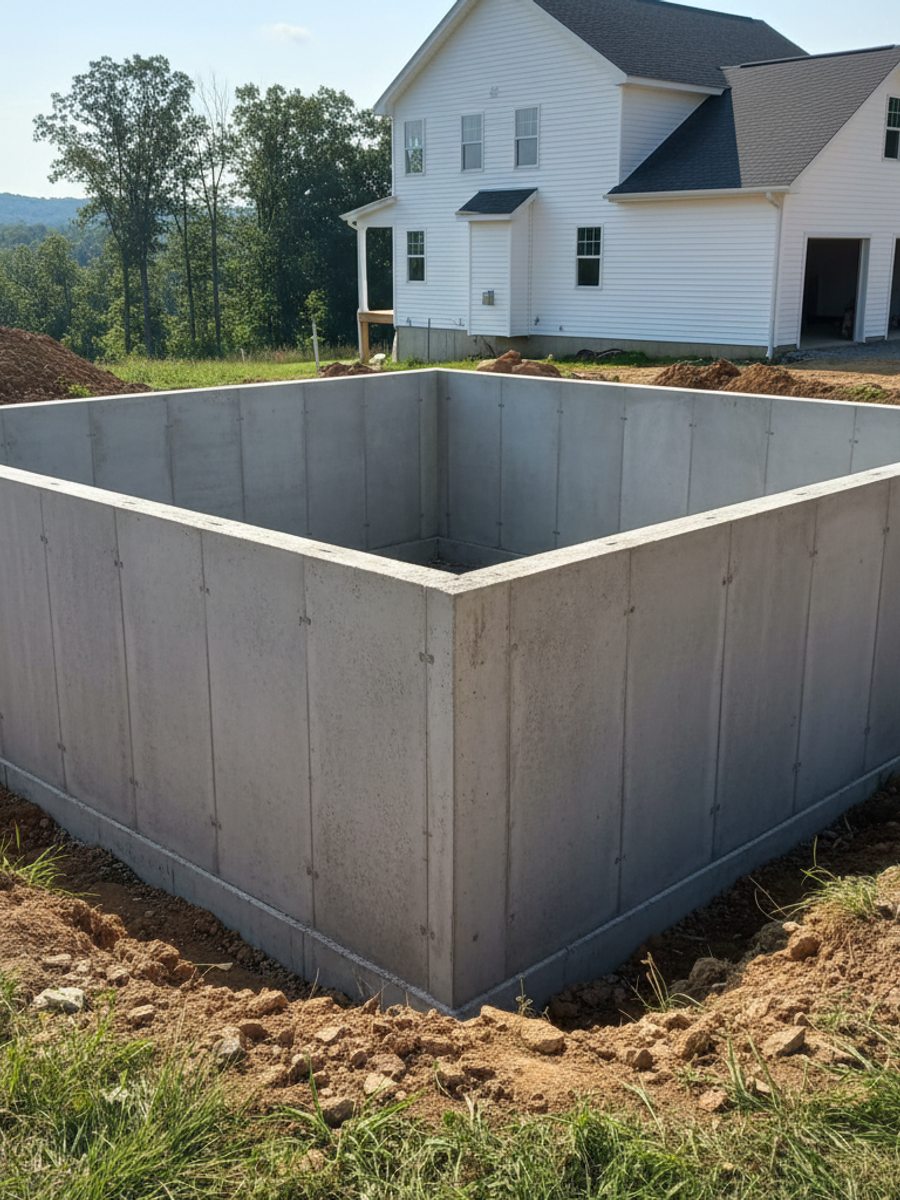
Frost depth in this part of Pennsylvania typically runs 30 to 36 inches, which is why any footing for a foundation wall or a retaining wall over a few feet tall has to sit below that line no matter what month you pour. A shallow footing poured in fall can heave the following winter if it's above frost depth, and a year or two later that shows up as a cracked step or a wall that's started to lean.
Soil around Harrisburg varies more than most people expect. Closer to the Susquehanna you get silty, alluvial soil that drains reasonably well but compacts poorly when wet. Head toward Mechanicsburg or Camp Hill and you're in Cumberland Valley limestone country, where karst geology means occasional sinkhole activity and soil that can settle unevenly over old voids underneath. Neither is a reason to avoid the work. It's a reason to test and prep the subgrade properly before anything gets poured, and it's part of why we look at the actual lot before we commit to a season, not just the calendar.
Permits don't run on a season
Harrisburg and the surrounding townships, Susquehanna, Swatara, Lower Paxton, and the rest, each handle permitting through their own building or zoning office, and most concrete work that changes grade, adds a structure, or touches a foundation requires one. A driveway apron that ties into a public street may also need a right-of-way permit. None of that changes by month, but it changes your timeline. If you want an early fall pour, get the permit application moving in summer. Footing and rebar inspections happen before the pour goes in, and waiting on that review is the most common reason a good-weather pour date slips.
So when should you actually book it
If the job is flexible, late September through mid-November is the safest bet in this area. The ground has dried out, temperatures are moderate, and the concrete gets weeks of decent curing weather before any hard freeze. Late spring, once the ground has firmly dried out from snowmelt, is the second-best option. Summer works fine with a crew that manages the heat correctly. Winter is for small jobs and repairs, not full driveways or slab foundations, unless there's a reason the work truly can't wait.
None of this replaces looking at your specific lot, your grade, and what's already sitting in the ground there. That's the conversation worth having before you pick a date. Pacific Concrete Co handles driveways, patios, walkways, and repair work throughout Harrisburg and the surrounding towns, and we'll tell you straight whether your timeline lines up with what the concrete has to do to cure right.