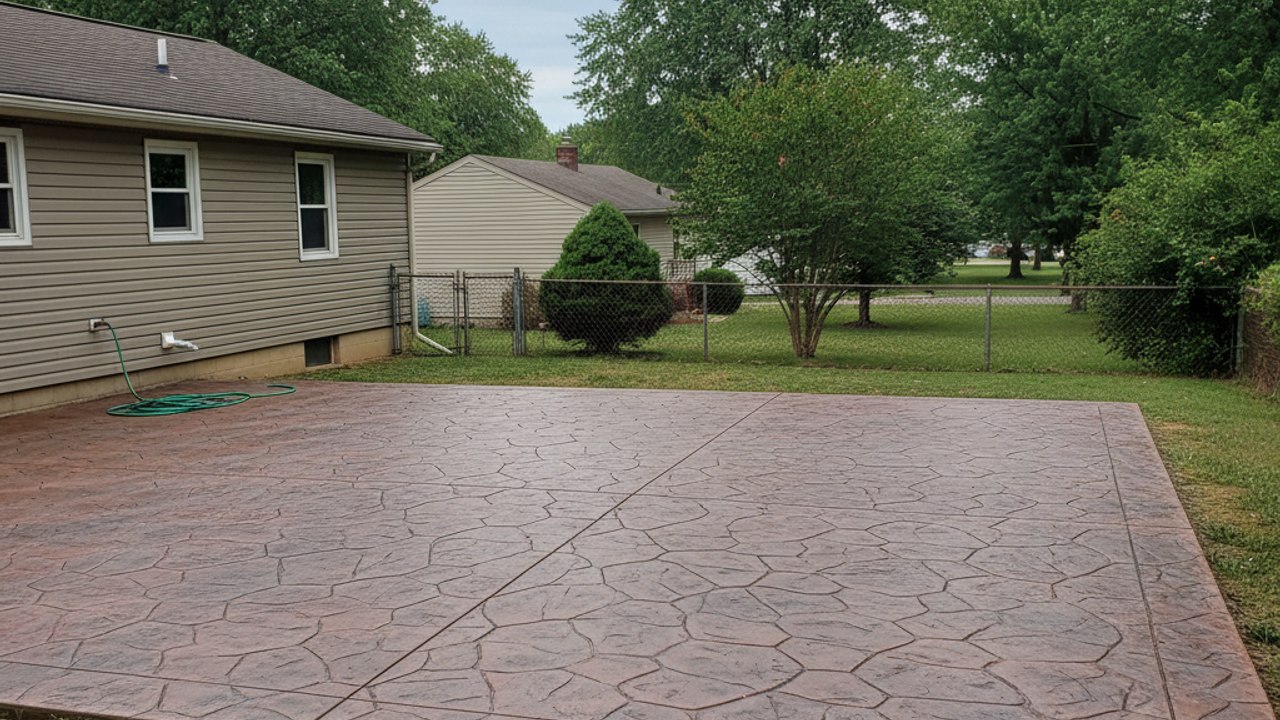
Concrete work looks simple from the sidewalk. Forms go up, a truck shows up, the crew screeds it flat, and a few weeks later you've got a driveway. What you can't see from the sidewalk is the part that actually decides whether that driveway is still flat and crack-free in ten years, and that part happens before the truck ever arrives. Choosing the right contractor in Harrisburg means choosing someone who takes that part seriously, because the ground here doesn't make it easy.
Why the ground under your slab matters here
Dauphin, Cumberland, and Perry County soil is a mixed bag. In a lot of the older parts of the city and in the flats near the Susquehanna you're dealing with clay-heavy soil that swells when it's wet and shrinks when it dries out. Push a slab or a footing into that without proper compaction and sub-base, and you'll get heaving in spring and settling by August. Other lots, especially up toward the ridges, sit closer to shale bedrock, which drains differently and needs a different approach to excavation.
Then there's frost. Pennsylvania's frost depth runs 30 to 36 inches depending on the winter, and Harrisburg typically sees somewhere around 30 to 40 freeze-thaw cycles a season, not just a few hard freezes but repeated cycles of freeze and thaw that heave anything not set deep enough. Any footing for a foundation, a porch, or a retaining wall needs to sit below that frost line. A contractor who doesn't ask what your frost depth requirement is, or just matches whatever's already there without checking, is guessing.
What a real estimate actually spells out
A one-line quote that just says "driveway, $X" tells you nothing. A proper estimate for flatwork should specify the compacted stone base, usually 4 to 6 inches of crushed aggregate, and the slab thickness on top of it, typically 4 inches for a patio or walkway and 5 to 6 inches for a driveway that's going to carry a truck or a boat trailer. It should say what psi mix you're getting. Most residential flatwork runs 3,000 to 3,500 psi; driveways and anything that sees vehicle weight should be 4,000 psi or air-entrained mix so it holds up to our winters.
It should also say how the slab is reinforced. Wire mesh is common and fine for a lot of jobs, but it has a bad habit of sinking to the bottom of the pour if nobody pulls it up into position while the concrete is placed. Rebar, usually #3 or #4 bar on an 18 to 24 inch grid, holds its position better and is worth asking for on driveways and anything structural. And the estimate should mention control joints, cut roughly every 8 to 10 feet, within 24 hours of the pour. Concrete is going to crack somewhere as it cures and shrinks. Control joints just decide where.
Permits, inspections, and who's actually signing off
Inside the city, permits for driveways, retaining walls over a certain height, and any new foundation work go through the City of Harrisburg. Step outside the city into Susquehanna Township, Swatara Township, Lower Paxton, or Hampden, and each township handles its own permitting, so what one office requires isn't always what the next one does. A driveway that widens your curb cut or a retaining wall near a property line can also trigger a setback check, and if you're in one of the newer developments around Hampden or Silver Spring Township, there's a decent chance an HOA has its own rules about materials or finish on top of whatever the township requires.
Before anyone breaks ground, PA One Call (811) needs to mark utilities on the property. Skipping that step to save two days is how someone hits a gas line or a sewer lateral, and it's a step a legitimate contractor will never skip regardless of how simple the job looks.
What the age of your street tells you
A lot of neighborhoods around Allison Hill, Midtown, and Bellevue Park were built in the early 1900s through the 1950s. Sidewalks and driveway aprons from that era were often poured thin, with no rebar, over a base that's been disturbed a dozen times since by tree roots and old utility work. Removing and replacing concrete on those streets usually means dealing with unknowns underground that a subdivision built in the last 30 years simply doesn't have. Newer neighborhoods out toward Hampden or Lower Paxton tend to have better original grading and more consistent fill, which makes the excavation and base work more predictable, though not foolproof.
Grading matters everywhere. Water needs to move away from the house at a slope of about a quarter inch per foot, minimum, out to daylight or a storm drain. A patio or driveway poured dead flat, or worse, sloped back toward the foundation, will hold water against the house every time we get one of our heavy spring downpours, usually March through May, and that's a problem that shows up in your basement, not on the slab.
Red flags worth walking away from
- No written contract, or a contract that doesn't list thickness, mix strength, or base depth.
- Wants full payment up front, before a single yard of concrete is delivered.
- Won't say who's pulling the permit, or tells you it's not needed when the scope of the job clearly requires one.
- No proof of insurance. If a worker gets hurt on your property or a pump truck cracks your driveway backing in, you want to know that's covered and not coming out of your pocket.
- Pushes to pour immediately after excavation without letting the sub-base settle or compact properly.
- Can't tell you how many days before you can drive on it. A driveway generally needs about 7 days before regular vehicle traffic and closer to 28 days to reach full strength. Someone rushing that timeline is rushing the whole job.
Questions worth asking before you sign anything
Ask what happens if it rains the day of the pour, or the day after. Fresh concrete and a downpour within the first 24 hours is a real problem, and a contractor with a plan for covering or rescheduling knows what they're doing. Ask how they handle an existing slab that's cracked or settled, since a lot of driveway and patio jobs here start with removal and demolition of something old, and disposal of that debris should be spelled out, not left as a surprise line item. Ask for a couple of addresses of past work you can drive by, even informally. You don't need a contractor with a long history, but you do need one who can show you flatwork that's held up through a winter or two.
Concrete work is one of those trades where the mistakes don't show up on day one. They show up the following spring, after the first real freeze-thaw cycle, as a crack running the wrong direction or a corner that's started to lift. Hiring someone who explains the base prep, the mix, and the timeline before you ever see a truck is the best sign you've got that the finished slab will still look right in five years. If you're weighing a project anywhere in Harrisburg or the surrounding towns, take a look at our concrete contractor work and ask us the same questions you'd ask anyone else.